

I discovered this week that churches have Google reviews.
Perhaps you already knew this.
I didn’t.
Apparently, the Body of Christ can now be rated in exactly the same way as a kebab shop, a tyre retailer, or a motel beside State Highway 1.
Who knew?
The discovery came while reading a story about chiropractors. A growing number of New Zealanders, it seems, are choosing healthcare providers based on online ratings and reviews.
Fair enough. If someone is about to manipulate your spine, a little research probably isn’t a bad idea.
But then it struck me.
If chiropractors were being judged by Google reviews, I wondered whether churches had escaped the same fate.
They hadn’t.
Surely the Church of Jesus Christ, purchased by His blood, established by the apostles, and commissioned to preach the Gospel to the ends of the earth, hasn’t been reduced to a handful of yellow stars and a comments section?
It has.
Once upon a time Christians chose a church because of doctrine, conviction, proximity, family ties, or because it was the only church in town and that was that.
For most of Christian history, believers sought churches based on doctrine, discipleship, faithfulness and community. Today many people approach church the same way they approach a restaurant.
A random search of churches in Palmerston North reveals a treasure trove of ecclesiastical performance reviews.
One church is praised for its excellent community. Another for its amazing welcome.
Another for its anointed worship.
One receives favourable recognition for having plenty of seating. Another earns compliments for its toilet facilities.
And one church, which shall remain anonymous to protect the innocent, receives perhaps the greatest compliment ever bestowed upon a congregation:
“Good funeral venue.”
Not powerful preaching. Not spiritual transformation. Not life-changing discipleship. Good funeral venue. Honestly! Who reviewed that? Lazarus?
If we are going to lower churches to the same level as other services why stop at reviews
the possibilities are endless, we could start with an app and call it prayeradvisor where you
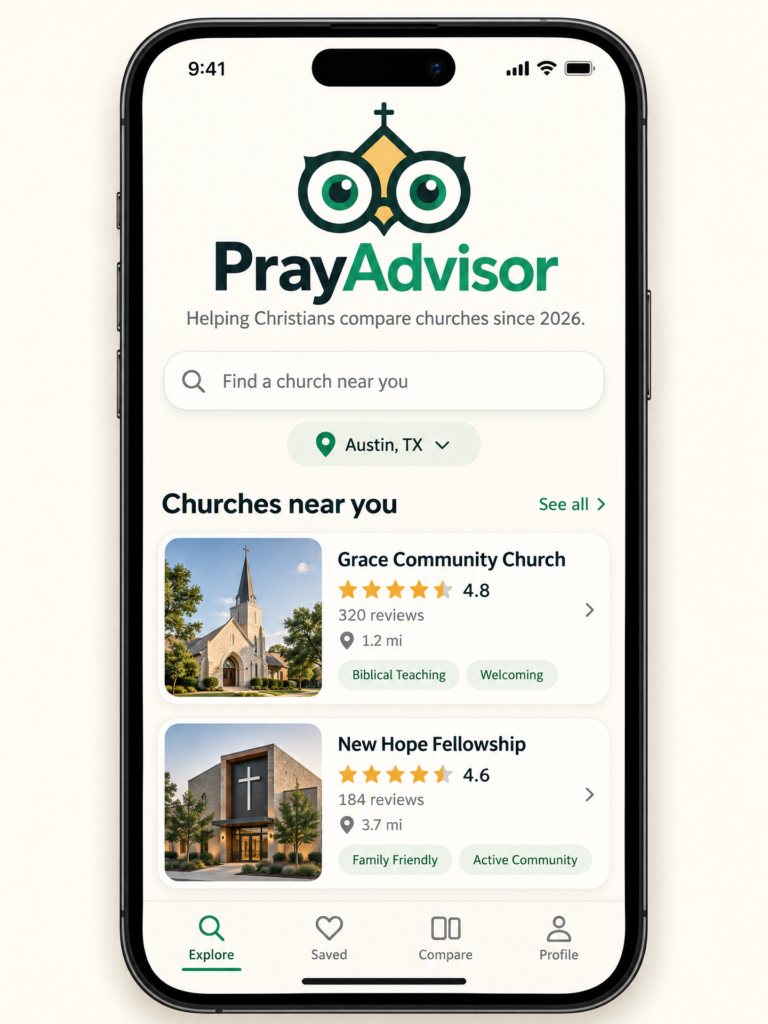
Rate your local congregation on
- Coffee Temperature ★★★★★
- Parking Convenience ★★★★★
- Length of Sermon ★★★☆☆
- Likelihood Pastor Will Challenge My Lifestyle ★☆☆☆☆
- Overall Customer Satisfaction ★★★★★
Better yet let’s go all out and yearly hold annual awards.
- Best Church Carpark.
- Excellence in Foyer Conversations.
- Outstanding Achievement in Biscuit Ministry.
- Lifetime Service Award for the Volunteer Who Has Been Making Tea Since 1987,
The possibilities are endless.
Imagine the Apostle Paul writing today.
“To the Church at Corinth: Congratulations on your 4.8-star rating. Unfortunately, you are still taking one another to court.”
Or perhaps a modern version of Revelation:
- “To the church in Ephesus: Strong doctrine. Children’s programme needs improvement. Three and a half stars.”
- “To the church in Sardis: Excellent facilities. Vibrant social media presence. Spiritually deceased.”
- “To the church in Laodicea: Fantastic coffee. Outstanding worship lighting. Lukewarm.”
The thing is, it feels uncomfortably familiar.
Most of us have done it. We browse, compare, sample, shop around, We examine churches using the same approach we use when choosing accommodation for a weekend away.
We find ourselves asking what the facilities are like, whether we’ll enjoy the experience, how good the music is, and whether the church caters to our preferences.
None of those questions are necessarily wrong.
But they are revealing.
For years we’ve told ourselves that consumer culture stops at the church door.
Perhaps it doesn’t.
Perhaps we’ve carried it inside with us.
Then again, maybe the reviews aren’t the problem.
Maybe we are.
Google didn’t create this mindset.
It merely exposed it.
The uncomfortable reality is that Google didn’t create this mindset.
It merely exposed it.
Long before online reviews existed, many Christians were already looking for a church that suited them rather than a church that challenged them.
We were already measuring success through comfort instead of conviction.
We were already judging churches by what they could offer us rather than asking what God required of us.
When Jesus reviewed churches, His approach was strikingly different.
The churches of Revelation were examined according to standards that would seem almost foreign in today’s religious marketplace. Christ looked for believers who remained faithful when compromise was easier, who held fast to truth when error was fashionable, and who continued to love Him when faith had become routine. He measured their spiritual condition, not their customer satisfaction scores.
If those seven churches appeared on Google today, one wonders how different the ratings might be.
Would a church receive one star because the sermon was too challenging?
Would another lose points because the worship wasn’t contemporary enough?
Would the church commended by Christ receive fewer reviews than the church with better branding?
That brings us to an uncomfortable thought.
What does biblical integrity look like in an age where reputation is increasingly managed rather than earned?
The Apostle Paul wrote that church leaders should have a good reputation with outsiders. Titus was instructed to appoint leaders of proven character. Scripture has always valued a good name.
But a biblical reputation was built among people who actually knew you.
Today’s reputation can be manufactured through marketing agencies, search engine optimisation, strategic branding and carefully curated reviews.
The danger is not technology itself.
The danger is allowing consumer culture to redefine the Church.

If Google becomes our primary guide, we may gradually find ourselves choosing churches for convenience rather than conviction, experience rather than discipleship, entertainment rather than truth, and personal preference rather than spiritual growth.
Perhaps the most important question is not whether churches should have online reviews. In a digital world, That ship has sailed.
The real question is whether we’ve begun choosing churches for the same reasons we choose restaurants.
And if we have, then an even more uncomfortable question follows.
Have we allowed the culture of the world to infect the way we choose to worship?
Jesus reviewed the churches of the first century.
His verdicts often bore little resemblance to what the surrounding culture valued.
He wasn’t looking for good parking, quality coffee, modern facilities or polished branding.
He was looking for faithfulness.
Two thousand years later, perhaps the question every Christian should ask is not whether their church has a five-star rating.
The question is whether Christ would give it one.
Because when Christ reviews His Church, His assessment is the only one that ultimately matters.